MISSING IN MISKATONIC / MURDER IN THE MONASHEE MOUNTAINS (Travis Daniels Investigations 1 & 2) by JP Behrens-reviews & interview
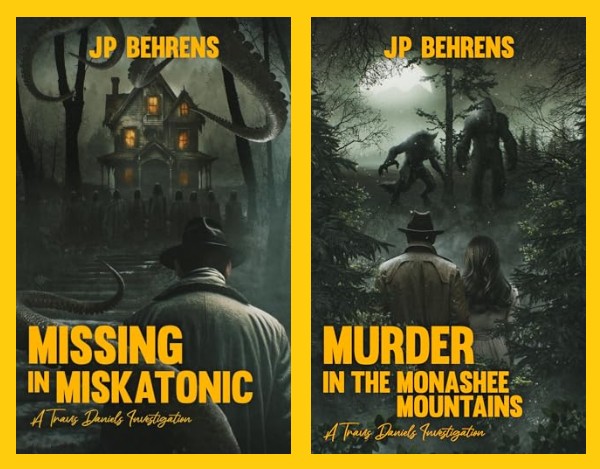
MISSING IN MISKATONIC
Travis Daniels Investigation 1
by JP Behrens
Genre: adult, supernatural, thriller
Release Date: August 23, 2024
Amazon.com / Amazon.ca / Amazon.uk / Amazon.au /
Don’t own a Kindle? Download the FREE Amazon Kindle App for your mobile device or pc
Step into the shadowed streets of 1928 Arkham, where Miskatonic University holds secrets darker than the night.
In this supernatural thriller reminiscent of Raymond Chandler and H.P. Lovecraft, Private Detective Travis Daniels is thrust into a harrowing investigation when a young woman disappears without a trace. As Daniels delves deeper into the labyrinthine mysteries of the storied New England city, he uncovers a web of sinister cults, ancient rituals, and eldritch horrors that threaten not only his own sanity but the fabric of reality itself.
Set against a city steeped in occult lore and clandestine experiments, Missing in Miskatonic blends elements of hard-boiled detective fiction with chilling supernatural encounters. Daniels navigates treacherous alliances and confronts malevolent entities lurking in the shadows, all while racing against time to unravel the truth behind the girl’s disappearance.
•••••
REVIEW: MISSING IN MISKATONIC is the first instalment and novella in JP Behrens’ historical adult TRAVIS DANIELS INVESTIGATIONS dark, supernatural thriller series.
Told from first person perspective (Travis) MISSING IN MISKATONIC follows PI Travis Daniels as he is tasked with locating a young college student Leslie Owens. The year is 1928, and Travis Daniels has been offered a large amount of money by a man who may or may not be human, to find a young woman who has disappeared without a trace but the deeper Travis Daniels digs, the stranger the trail of evidence becomes. From the horrific to the supernatural, Travis Daniels must come to terms with creatures that stand in his way, as the small town of Miskatonic hides its’ secrets behind the doom and gloom of horror.
With a nod to the fictional institutions and occult world developed by author H.P. Lovecraft, the world building is dark and gritty as PI Travis Daniels ventures into a world of demons and monsters in the search for a woman who may or may not want to be found. Searching the libraries for information, Daniels discovers a world he knows nothing about but a world that is on the brink of destruction and chaos.
Travis Daniels is a no-nonsense, practical hardened PI who has been thrown to the proverbial wolves and the malevolent supernatural creatures of nightmares. MISSING IN MISKATONIC is a dramatic and edgy story of the occult -ends on a cliff hanger, you have been warned
Copy supplied for review
Reviewed by Sandy
______
MURDER IN THE MONASHEE MOUNTAINS
Travis Daniels Investigation 2
by JP Behrens
Genre: adult, historical, supernatural, thriller
Amazon.com / Amazon.ca / Amazon.uk / Amazon.au /
Release Date July 11, 2025
After barely escaping the haunted streets of Arkham and Miskatonic University, Travis Daniels is on the run with his ward, Leslie Owens. Seeking refuge in the remote woods of Monashee Mountain, their lives take another dark turn when they witness a brutal, savage murder. Now, they’re thrust into a web of deceit, danger, and old grudges as they are drawn into a conflict between warring factions in the small town of Tonasket.
Travis must navigate the escalating tension between the town’s residents, the Native American tribes, and the ancient, shadowy creatures that dwell in the wilderness. The clock is ticking as dangerous rivalries between Sasquatch and werewolves threaten to erupt, and the local logging operations are sabotaged by forces more sinister than anyone can imagine.
As Travis works to uncover the truth behind the murder, he must decide who he can trust before it’s too late. With danger closing in, only one thing is certain: the truth will come at a cost.
•••••
REVIEW: MURDER IN MONASHEE MOUNTAINS is the second instalment in JP Behrens’ historical adult TRAVIS DANIELS INVESTIGATIONS dark, supernatural thriller focusing on PI Travis Daniels. MURDER IN THE MONASHEE MOUNTAINS can be read as a stand alone but I recommend reading the series in order for back story and cohesion. MURDER IN THE MONASHEE MOUNTAINS, set in 1929, picks up approximately one year after the events of book one MISSING IN MISKATONIC. If you have not read book one, there may be spoilers in my review
NOTE: Due to the nature of the story line premise including racism, discrimination and stereotyping, there may be triggers for more sensitive readers
Told from first person (Travis) and omniscient third person (Leslie) MURDER IN THE MONASHEE MOUNTAINS finds PI Travis Daniels, and his companion Leslie Ward on the run, desperate to stay ahead of the people they left behind in Arkham Massachusetts, Travis and Leslie, once again, find themselves front and centre in another supernatural mystery but this time involving the possibility of were-wolves, sasquatch, magic and Indigenous lore, as they are the only witnesses to a possible murder involving the creatures of mythology and fiction. A logging company is ravaging the lands once held by the Indigenous peoples, and someone or something is taking steps to stop the destruction of the Earth before it is too late.
The world building follows Travis and Leslie as they are pulled into an investigation involving superstition, discrimination, magic and murder. Reflecting the ongoing tragedy of indigenous lands appropriation , MURDER IN THE MONASHEE MOUNTAINS focuses on capitalism, a fight for survival, freedom and rights.
MURDER IN THE MONASHEE MOUNTAINS is a story of betrayal and vengeance, power and control, magic and violence, discrimination and bigotry. The premise is dark, dramatic and intense; the characters are desperate, determined and dynamic.
Copy supplied for review
Reviewed by Sandy

TRC: Hi JP and welcome to The Reading Café. Congratulations on the release MURDER IN MONASHEE MOUNTAINS
JP: Thanks for having me. It’s really exciting to see this next chapter in the Travis Daniels Series hit the shelves. Hopefully, everyone will enjoy it and be ready for book 3 which I’m currently working on.
TRC:We would like to start with some background information. Would you please tell us something about yourself?
JP: I’m pretty boring, honestly. I spend my days reading and writing. I practice kung fu, run errands, and play video games when my daily writing routine is done. I wish my life was a little more exciting to I had something to say when asked this, but it’s probably for the best. If I had too much going on, I’d never get words on the page.
TRC:Who or what influenced your career in writing?
JP: As I’ve grown as a writer, the list of influences grows. I first started out wanting to write DragonLance books because of Margaret Weis and Tracy Hickman. Eventually, I branched out in my reading and discovered Bradbury, Vonnegut, Twain, etc. More recently, I’ve been steeping my brain in Haruki Murakami and other international writers. I still read a lot of American Literature, but if I want to get better and, maybe, inspired the next generation, I need to keep striving to improve my work. You can’t get better within an echo chamber of cultural influences.
The other element that has influenced my writing is the role-playing game (RPG) genre of video games. I played Final Fantasy, Dragon Quest, and more growing up. I still play many of those series today. I love the sweeping stories told throughout the games and having to explore those worlds. When someone asks me about my love of games, I always explain that, for me, video games are just interactive novels. I care about the story more than the mechanics and graphics; though, if those aspects of the game are quality, it serves to enhance the overall experience.
TRC:Who are some of your favorite authors of the supernatural genre?
JP: Well, there’s the big one, Stephen King. I loved Poe from a very early age and once or twice tried to emulate his work. It did not turn out well.
Today, I read all over the place. I loved Slade House by David Mitchell and hope to write a similar kind of haunted house story in the future. The Haunting of Hill House is another great haunted house book. Junji Ito writes and draws some out-there stories that are always fun to read. Victor LaValle never disappoints. I’m not sure if he counts as supernatural, but Bradbury has a knack for writing stories that haunt you long after you’ve finished them.
There are of course many more like Kafka, Lovecraft, Barker, Matheson, Bloch, Straub, McCammon, etc., but there is a finite number of hours and so many great books to read.
JP: What challenges or difficulties did you encounter writing and publishing your first book? This series?
The biggest challenge I had publishing my first book was not having the experience and skill to recognize how terrible it was! I tried for almost a year trying to get that mess picked up and eventually trunked it and moved on. Over time, my writing improved and I wrote several short stories that found homes in various anthologies which led to Portrait of a Nuclear Family getting published.
Once I have that first book out, I went through all my old projects and found a short story titles, “The Case of Leslie Owens,” and took some scissors to it. I was left with maybe half a page on solid writing and began developing it into a novella. Since it has a deep Lovecraftian root to it, I wanted to try and launch it at NecronomiCon in Providence, RI. I approached Crystal Lake Publishing, asked very politely, and they agreed to help me pull it off. They were also interested in supporting the series, so now I’m locked into delivering one a year for as long as people keep buying it or it comes to a natural end.
TRC : Would you please tell us something about the premise of MURDER IN THE MONASHEE MOUNTAINS and the TRAVIS DANIELS INVESTIGATION series?
JP: The TRAVIS DANIELS INVESTIGATIONS series follows the titular detective as he encounters cases that devolve into crimes involving supernatural powers. The first in the series, MISSING IN MISKATONIC, begins with Daniels coming off one job to be hired to find a missing girl. The case sends him to Arkham, MA and Miskatonic University where he comes face to face with elder gods, cultists, and malformed creatures beyond conventional description.
MURDER IN THE MONASHEE MOUNTAINS begins almost a year later while Daniels is on the run after the events of MISKATONIC. He stumbles across a murder and is swept up into a number of feuds between Canadian Sasquatch, Native America Werewolves, Native America Tribes, local townspeople, and a greedy lumber baron. He needs to solve the murder before fighting breaks out and whole towns are wiped off the map.
TRC:What kind of research/plotting did you do, and how long did you spend researching /plotting before beginning MURDER IN MONASHEE MOUNTAINS?
JP: MURDER IN THE MONASHEE MOUNTAINS was way more research than I’ve ever done. First, it takes place in real towns in Washington State. That required many phone calls and emails to local historical societies to get old photos, maps, news clippings, etc. They were wonderful and I wouldn’t have been able to include the level of detail without their assistance. I may have needed to invent some towns, which I wanted to avoid.
The other research intensive aspect of the book, and the reason I didn’t want to start inventing places, is the story features legitimate Native America tribes who exist through to today. The history of their reservation and how it was shrunk by the federal government is one of the many catalysts pressuring the characters in the book. I wanted to be both careful and respectful to their culture so I did quite a bit of research by reaching out to anyone within the tribe who could help me along. I even contacted one of the many people working to keep their native language alive. There are several words and phrases throughout MURDER IN THE MONASHEE MOUNTAINS that are true to their language and I’ve includes a glossary and pronunciation guide for readers. I take a lot of pride in how much work I did in this book, but I think I’ll be sticking to fictional towns in the future.
TRC:Did you always plan to have a supernatural element to the series?
JP: Yes, always. I wanted to write a hard-boiled detective story with a main character who starts out a skeptic, is confronted by the supernatural, and adapts. Regardless of his ability to adapt, he will never embrace it and actively avoids getting involved. Of course, there will always be a reason he is forced to.
TRC:How many books do you have planned for the series?
JP: As many as I can possibly write and sell. You keep buying and reading them, I’ll keep writing them.
TRC:How do you keep the plot unpredictable without sacrificing believability or content?
JP: That’s a touchY tightrope to walk. I know many authors use a myriad of different techniques, but I try to stick to a couple I find useful. The first is The Hero’s Journey. It’s a lovely foundation to ensure you hit certain guideposts in your story but also allows for the freedom to still find your own path and write, what you can only hope are, original stories.
The second technique I use is called, “However, Therefore.” I found this while watching a video where Trey Parker and Matt Stone were discussing how they build each episode of SOUTH PARK. They call it something different, but I like my title better.
It’s essentially a way of ensuring cause and effect throughout your story. i.e. Sam walked down the street. HOWEVER A man in black clothes, his face covered in shadows turned the corner in front of him. THEREFORE Sam attempted to cross to the other side of the road. HOWEVER The strange man followed him. THEREFORE Sam stopped in the middle of the street. HOWEVER The man stopped opposite Sam and continued to approach. Etc.
This allows for a writer to create a smooth sequence of events that are both unpredictable and maintain believability.
TRC:Believability is an important factor in writing story lines especially stories of mystery and suspense involving the supernatural. How do you keep the story line believable? Where do you think some author’s fail?
JP: Beyond using the “However, Therefore,” technique, I try to avoid my characters discovering unearned abilities or easy outs. They need to work and suffer for their victories.
Authors tend to fail in this when they don’t consider the cause and effect of what they are writing or giving their heroes too much power. Stories only succeed when they have an obvious conflict where the hero winning is against the odds. If our main character miraculously learns a skill necessary for victory at the last second without struggling to master it, what’s the point? As a reader, I want to see the characters struggle and persevere, not just stumble on the solution. Well, unless you’re writing a comedy, stumbling is part of the genre.
TRC:Do you believe the cover image plays a deciding factor for many readers in the process of selecting a book or new series to read?
JP: Absolutely! I’ve been selling my books at conventions and shows and I’m still shocked by how many people comment on my covers and mention how the cover “looked intriguing,” so they picked it up and read the back. Your cover is often the book’s first chance to make an impression with a perspective reader.
TRC:When writing a storyline, do the characters direct the writing or do you direct the characters?
JP: I tend to lean more on the side of the writer directs the characters. While I’m writing, I may start feeling a groove between two characters having a conversation that starts to go off the rails of my intended arc. When that happens I look at whether it’s interesting or not.
If so, I keep going and see where it’s heading. I can always find a way to bring it all back to where I want. Sometimes I discover a fun solution to a problem I’d been mulling over for a bit.
If the conversation is boring, I delete back to the point it when sideways and fix it. As the author, I’m in charge of what’s happening. I tend to maintain a rough plot and always keep in mind the next road sign in the journey. My characters have a small amount of latitude to explore side roads, but they are still going to end up where I want them to be.
TRC:The mark of a good writer is to pull the reader into the storyline so that they experience the emotions along with the characters. What do you believe a writer must do to make this happen? Where do you believe writer’s fail in this endeavor?
JP: This is a tricky one. I tend to employ a kind of Method Acting while writing intense scenes. I try to put myself in the character’s headspace and see what the most likely reaction is going to be. Being neurodivergent, I don’t always react in the expected ways, so I have trusted beta readers who know to keep an eye out this.
One of the most difficult elements of writing, in my opinion, is emotional resonance. Writers tend to fail at it because they aren’t thinking about it, don’t know to work for it, don’t have the words yet, or solely focused of plot. It takes practice and intention to address it.
TRC:Do you listen to music while writing? If so, does the style of music influence the storyline direction? Characters?
JP: I do listen to music. It doesn’t effect my writing, characters, or pace. I use it to stay focused. If I don’t have music on in the background, my subconscious mind will wander and I don’t get as much done.
TRC:What do you believe is the biggest misconception people have about authors?
JP: That we are all rich or that we are actively looking for stories to write that aren’t our own.
To make a living as an author on only your words is extremely difficult, especially in a world that doesn’t value art as much as it once did. Back in the 60’s and 70’s, one could make a decent living writing short stories. Kurt Vonnegut, Jr. quit his day job when he worked out if he sold just four short stories a year, he would match his current salary. There is no way that is true of today, not even if you sell regularly to the top paying venues.
Most writers scrape out a living until they get a lucky break and their book gets picked up for a movie or television series. Not even then, sometimes. It’s a lot of work and takes a lot of support from loved ones. I wouldn’t be writing as much as I do without my wife’s constant faith in me.
And no, I’m sure your idea is wonderful, but I have more than enough of my own. I always say they should go and write their own book.
No one is going to tell your story better than you provided you put the work in.
TRC: What is something that few, if anyone, know about you?
JP: Very little, honestly. I’m an open book and will answer damn near any question with the unfiltered truth. I find it stressful to edit myself in conversations which is one reason I will often take a back seat to many group discussions in social situations. When I’m working at a convention, either behind my table or on a panel, I present as very extroverted. In reality, I want to curl up in the corner and disappear. The constant worry I’ll make a fool of myself nags at my mind all the time. If you see me at the bar after the vendor hall is closed and the panels are done, I am lost. I have no idea how to act with confidence in that social situation.
TRC:On what are you currently working?
JP: I am editing the first book in a young/new adult fantasy series. Sorry, but there is no romance in it. If you ever read it, you’ll understand a romantic subplot would be highly problematic. It does explore the nature of friendship, though.
Also, I’m finishing up the rough draft of an urban fantasy novel while starting book three of the TRAVIS DANIELS INVESTIGATIONS series. After that will be a dark fantasy horror novel. I have a full plate.
Then there is my Patreon! I do a weekly check-in that is free for those who join. I’m trying to build a community there where we can all celebrate our successes as creators. For the paid membership, I post one short story, one chapters in an ongoing thriller novel, one craft article, and whatever else I feel like writing per month. I am obsessed with making sure I give anyone who pays me value for their money.
I started the Patreon because when I left all Meta platforms, I wanted to maintain the relationships I had with several of my readers.
TRC:Would you like to add anything else?
JP: I don’t think so! This is a very thorough interview. I only hope that those who read my work are open to following me across genres. My work spans several different genres mainly because I get bored easily. Hopefully, readers will start looking for the next JP Behrens book rather than the next horror novel, sci-fi novel, or next Travis Daniels. If my work helps reader expand their interests, then I’ll achieved one of the many goals I have for myself and my work.
LIGHTNING ROUND
Favorite Food–Pizza or Cheeseburger (I told you all I’m BASIC!)
Favorite Dessert–Brownie Sundae
Favorite TV Show–Babylon 5
Favorite Sport –eSports
Last Movie You Saw–Thunderbolts*
Dark or Milk Chocolate–Milk Chocolate
Secret Celebrity Crush–Katie Holmes
Last Vacation Destination–Disney
Do you have any pets?–One cat, one goldfish, and exploring a dog.
Last book you read–JOURNEY TO THE WEST by Wu Cheng’en
TRC:Thank you JP for taking the time to answer our questions. Congratulations on the release of MURDER IN THE MONASHEE MOUNTAINS. We wish you all the best.